Organize user interview notes by preserving each participant's original record, separating quotes from observed behavior and interpretation, then comparing interviews around the same research question. Link each finding to evidence, state its limits, and identify what needs to be tested next.
“Users need better search” can hide several problems: not knowing where a file was shared, not recognizing the current version, or lacking access. Preserve those differences before turning them into a feature proposal.
Give every interview a traceable source
Riley, a product designer, is investigating how people retrieve shared deliverable files. Use participant IDs U01, U02, and U03, and record the date, work context, and research question. Keep interviews separate so a synthesis can point back to its sources.
The example compares three records without using their proportions to estimate demand across all users. If recordings or screenshots are retained, obtain the relevant consent and note their locations so references can be checked later.
Separate quotes, observations, and interpretation
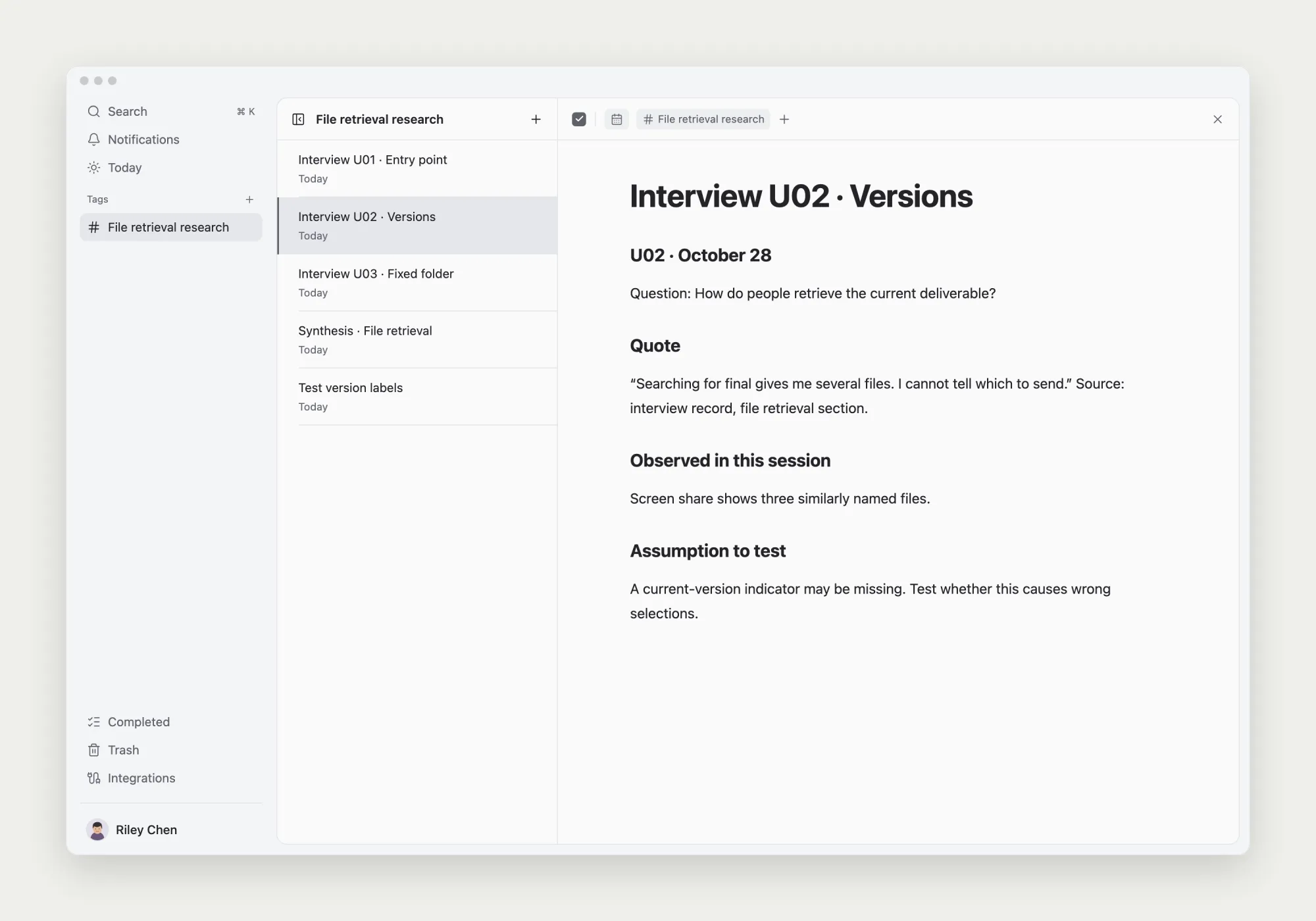
U02 recalls searching a chat for “final” and finding several similar files. A screen share during the interview also shows similar file names. “I sent an old version before” is a reported experience; the file names visible during the session are a current observation. Record the source of each.
| Record type | Example | What to retain |
|---|---|---|
| Quote | Searching for final gives me several files; I cannot tell which to send | Speaker and reference location |
| Observation | Screen share shows three similarly named files | What was directly visible in the session |
| Interpretation | There may be no clear current-version indicator | Mark as an assumption to test |
Mark unclear wording or missing context for follow-up. If someone proposes a search button, keep the suggestion and ask about the last retrieval attempt: its starting point, steps, and failure. The suggestion alone does not establish that a button will solve the problem.
A user interview notes template to copy
Research question:
Participant ID and relevant background:
Date / interview format / note taker:
Recording or screenshot consent and source location, if applicable:

Most recent concrete experience:
- Trigger and goal:
- Actual steps and materials:
- Friction and its consequences:

Key quotes, with references:
Behavior directly observed in this session:
My interpretation or assumption:
Information to check and conflicting evidence:
What to ask or test next:Put the template in a task note before the interview and prepare the research question and prompts. Afterward, verify quotations and add observations. If no interaction was observed, retain the account as reported experience instead of upgrading it to observed behavior.
Compare records around one research question
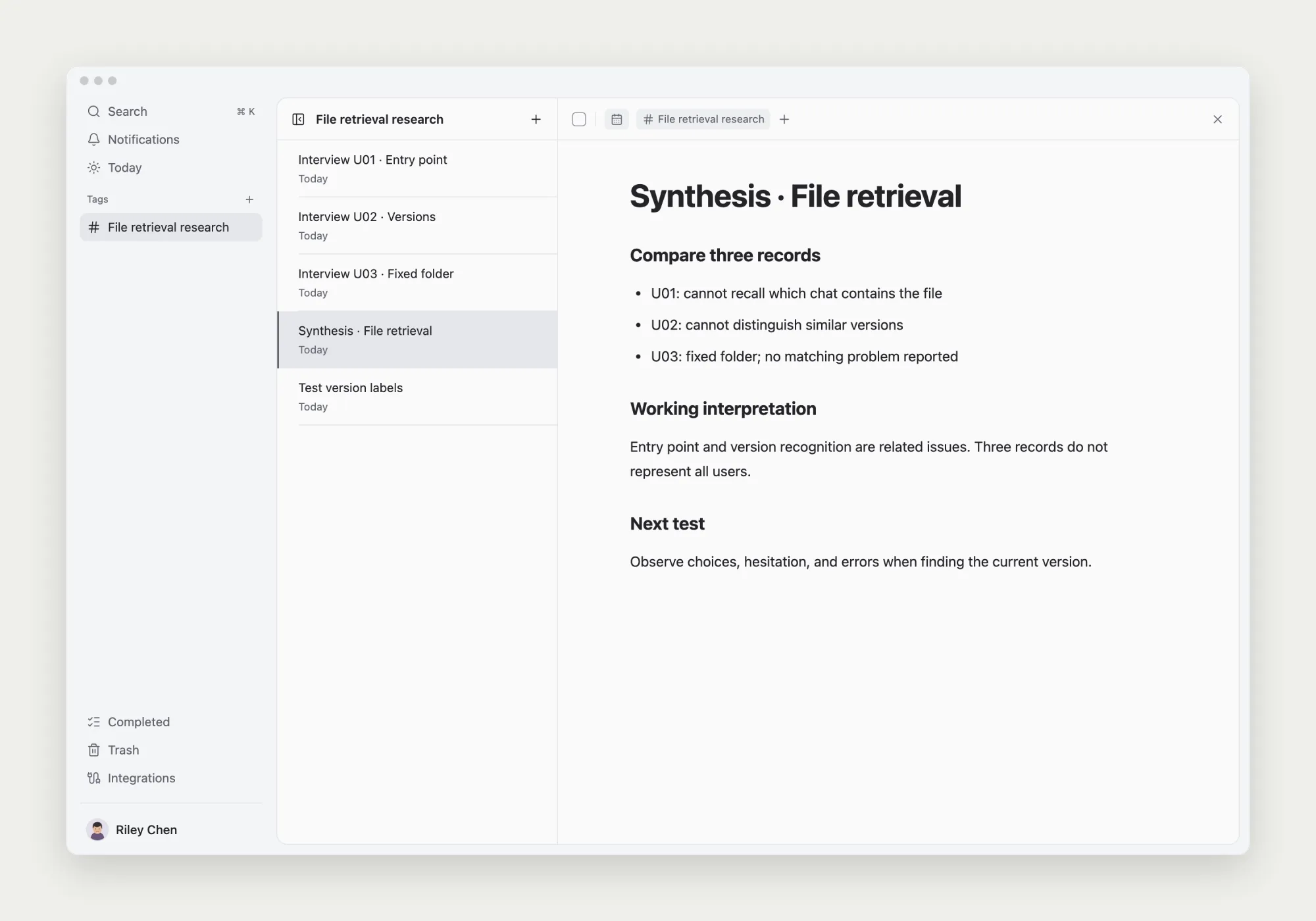
U01 cannot remember which conversation contains the latest file. U02 cannot distinguish several “final” versions. U03 uses a fixed delivery folder and reports no comparable difficulty in this interview. Retrieval location and version recognition emerge as related but distinct issues.
| Record | Context and evidence | Open question |
|---|---|---|
| U01 | Retrieves files through chat; cannot recall where one was sent | Would a stable entry point improve retrieval? |
| U02 | Similar names make the current version unclear | Would version labeling reduce wrong selections? |
| U03 | Uses a fixed delivery folder; no matching problem reported | How much do team delivery conventions explain this? |
In TodoNote, give interview tasks and the synthesis task the same research tag. Write findings and supporting participant IDs in the synthesis note, then return to individual interviews when checking evidence. Tags group records; they do not perform the analysis automatically.
Write findings with clear boundaries
A defensible summary is: “Across these three records, U01 and U02 had file-location or version-recognition problems; U03's fixed-folder approach deserves a closer look.” It preserves both support and variation. A claim that all users need global search would skip several decisions between the evidence and a solution.
Create a follow-up task to test whether version labels reduce wrong-file selection. Prepare several versions, ask participants to find the current deliverable, and record choices, hesitation, and errors. Use the result to decide what to do next; the interview finding is the starting point for validation.
Preserve original records after synthesis
Date corrections and retain context. Bring only decision-relevant evidence into the summary, with full interview records remaining in their original tasks. If retrieval becomes difficult, use the note-tag organization guide to improve access.
Nielsen Norman Group's discussion of user interviews explains why self-report and actual behavior differ and why specific design questions also need observation. Identifying evidence sources makes it easier to choose an appropriate follow-up method.