A content week can start with who an article helps and what the reader should be able to do. Work backwards to source gathering, writing, checks and publication. Add unresolved reader questions to the original task, then choose whether to update the article, investigate a new topic or keep observing. The next week gains a source for its ideas.
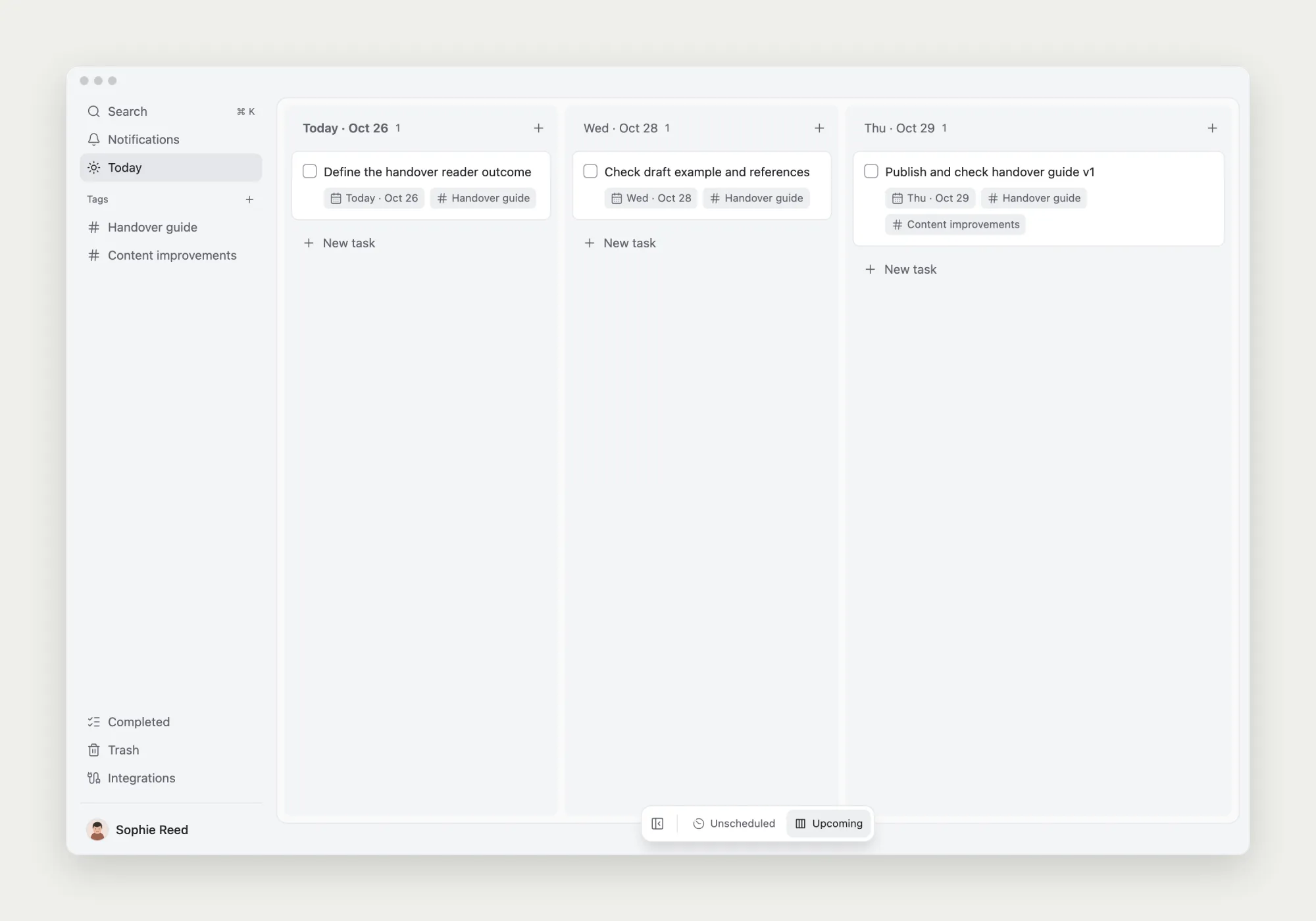
Sophie is publishing a first-time project handover guide. Monday defines the reader outcome, Wednesday checks the draft, Thursday publishes and Friday reviews feedback. The guide covers current status, material locations and the next action; it does not attempt every multi-person handover issue.
Define what the reader should finish with
Write ‘Help someone prepare their first usable handover’ and list what it must answer: where the work stands, where supporting material lives and what to do first. Title, outline and example should serve that result.
Plan scope Monday, materials Tuesday, writing and checks Wednesday, publication Thursday and feedback Friday. Use start dates for work and due dates for genuine channel commitments. Missing material needs a gathering task, not just a final writing deadline.
| When | Work to move forward | Record to keep |
|---|---|---|
| Mon · Oct 26 | Define the handover reader outcome | Scope and essential questions |
| Tue · Oct 27 | Gather example and supporting material | Sources, purposes and missing checks |
| Wed · Oct 28 | Write and check the draft | Example, links and boundaries |
| Thu · Oct 29 | Publish v1 and inspect the page | Version, location and checks |
| Fri · Oct 30 | Review questions and update the gap | Revision and a topic to investigate |
Keep material beside the question it answers
Record each source, its purpose and anything still unverified. The handover example needs status, material references and a first action. References must support their associated explanation, and screenshots must match the current steps.
If an example lacks details, note who should confirm what. Google’s helpful content guidance includes whether readers can achieve their goal as a self-check. Use that question to inspect the outline.
Publish with the version’s scope and checks
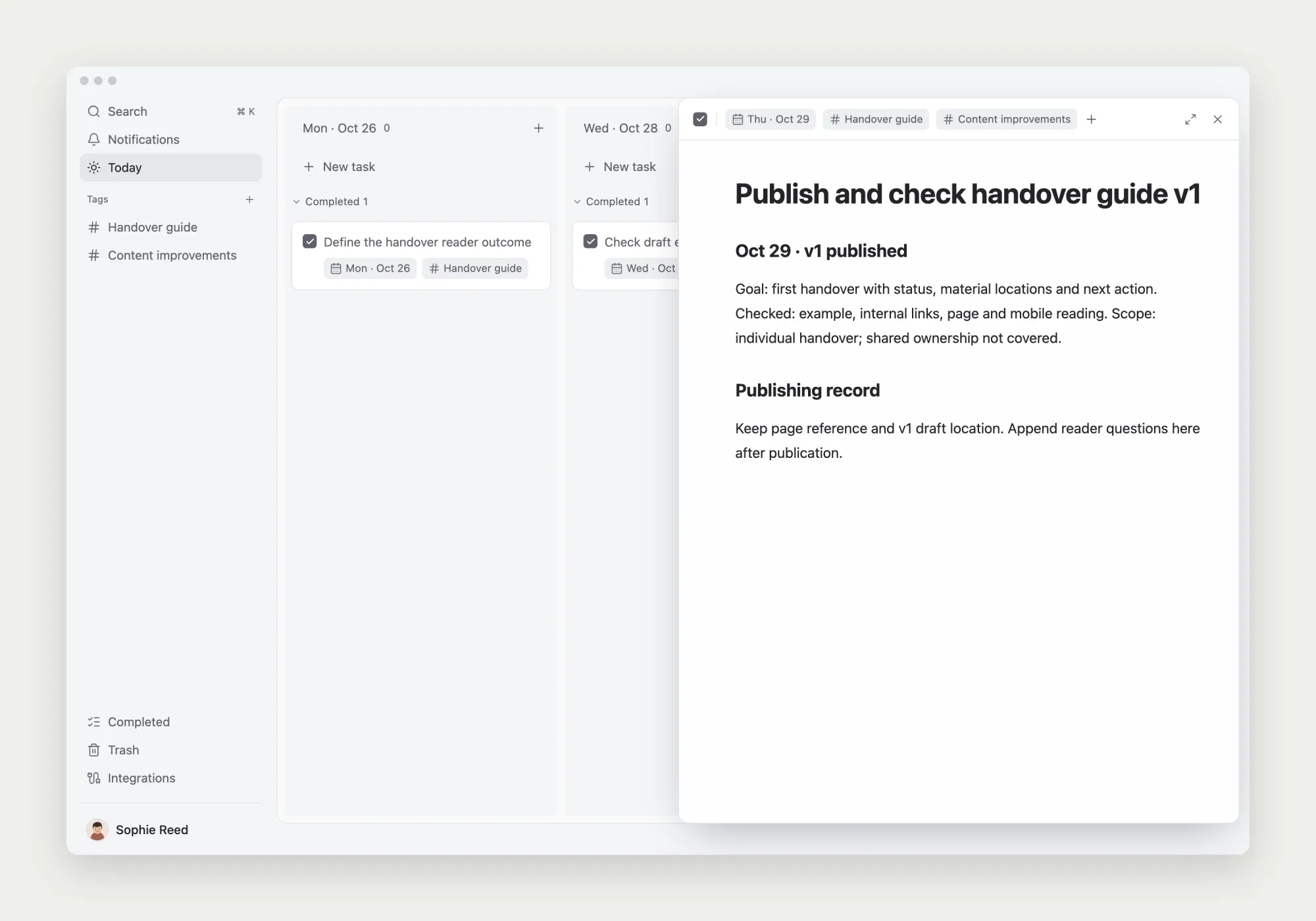
A finished draft and a published article are different states. Keep version, page reference, example and link checks, and coverage boundaries in the publishing task. This v1 explains an individual handover; dividing work across several people remains outside its scope.
Before closing the task, open the page and verify the title, steps, links and mobile reading. After publication, feedback can be appended to the same note without repeatedly reopening the completed publishing task.
Treat feedback as a question to inspect
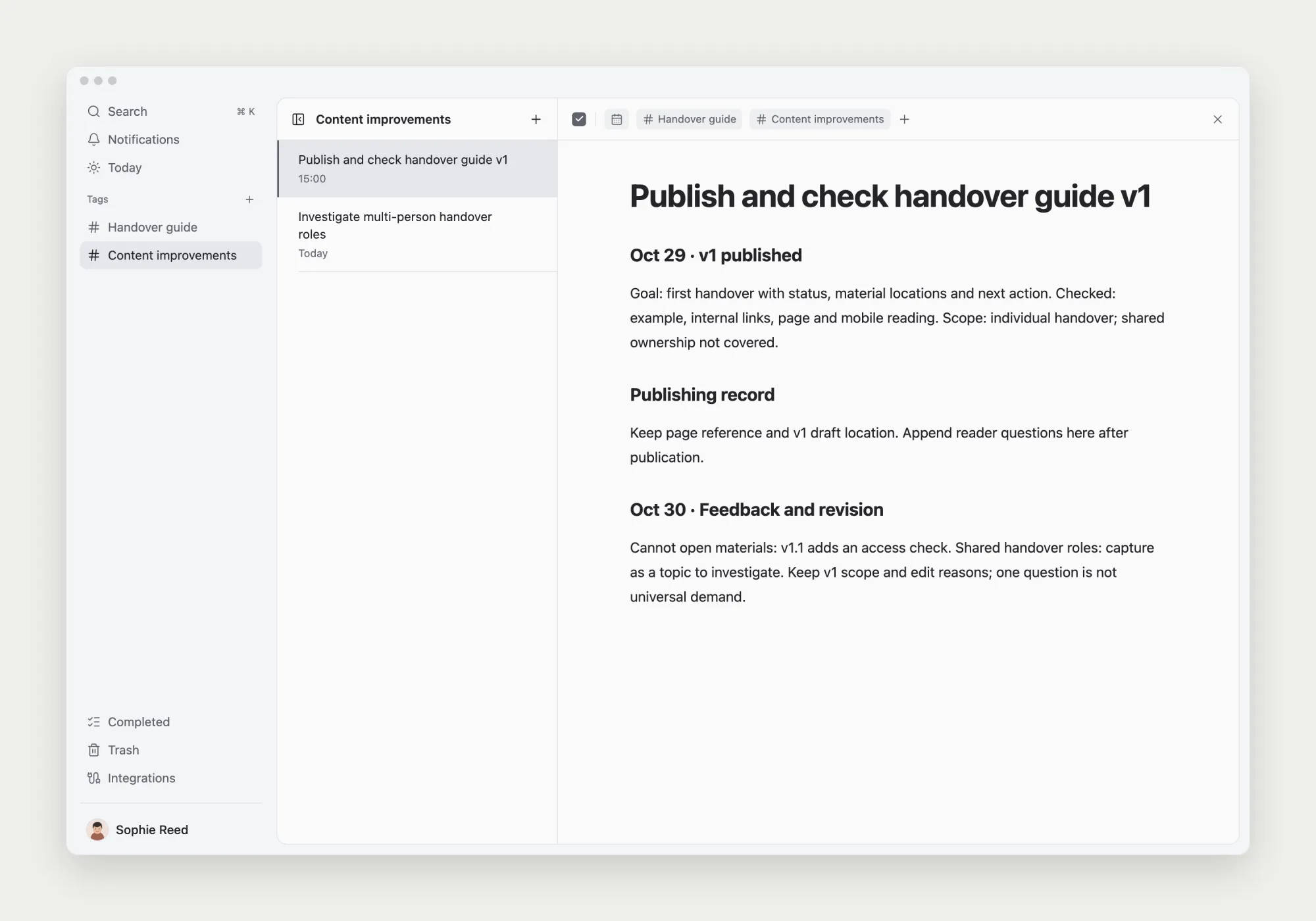
Friday brings two questions: what if the recipient cannot open a file, and who owns each part in a multi-person handover? The first exposes a missing access check within the guide’s promise. The second needs a separate topic decision.
Keep the source and date, then inspect whether the article already answers the question and where the reader got stuck. One question warrants checking, not a claim about every reader. A traffic change alone also cannot establish the effect of a revision.
Choose an update, a new topic or more observation
Tag the publishing task ‘Handover guide’ and ‘Content improvements’. Append that v1.1 adds an access check while preserving v1’s original scope. Use a separate task for the actual edit; leave multi-person ownership as a topic to investigate without promising a publication date.
Before the next guide, retrieve earlier omissions, questions and revision results through the topic tag. Use a weekly review for planning and recurring tasks for stable publishing checks. The next cycle can begin with an existing reader problem.