A Winter Arc is a late-year push to build routines and advance personal goals before the new year. If yours is losing momentum, reduce it to one main outcome and three concrete weekly actions. Give each action a smaller version and adjust from actual progress. You can restart from your own date instead of waiting for a shared starting line.
Daily posts can make the challenge look as if it requires fitness, early mornings, reading, and study at once. Your available time is different. A useful year-end plan should fit alongside work, family, and rest rather than depend on cutting sleep.
Pick an outcome you can inspect
Noah wants to publish a portfolio case study before year end. He replaces “improve everything” with “publish one design case with an explanation of the process.” His weekly actions are to organize material, draft one section, and review the work. Other routines need not become deliverables for this project.
Separate repeated behavior from the outcome. Writing twice a week is a process commitment; publishing the case is the result. A writing session does not finish the case, and one missed session does not invalidate the project. Record the current artifact so the following week has a clear starting point.
Prepare a minimum version for an ordinary day
The normal action might be organizing a set of materials; the smaller version might be captioning three images. It should still advance the same result, rather than substitute an unrelated activity just to maintain a streak. A busy week can also justify an explicit pause and a revised start date.
| Situation | Response | Record to keep |
|---|---|---|
| Too many simultaneous goals | Keep one main outcome | What this round excludes |
| A week has less available time | Use a smaller useful action | Actual material produced |
| Plenty of check-ins, little output | Review a milestone artifact | Draft, test, or publication record |
Review the artifact, not the streak
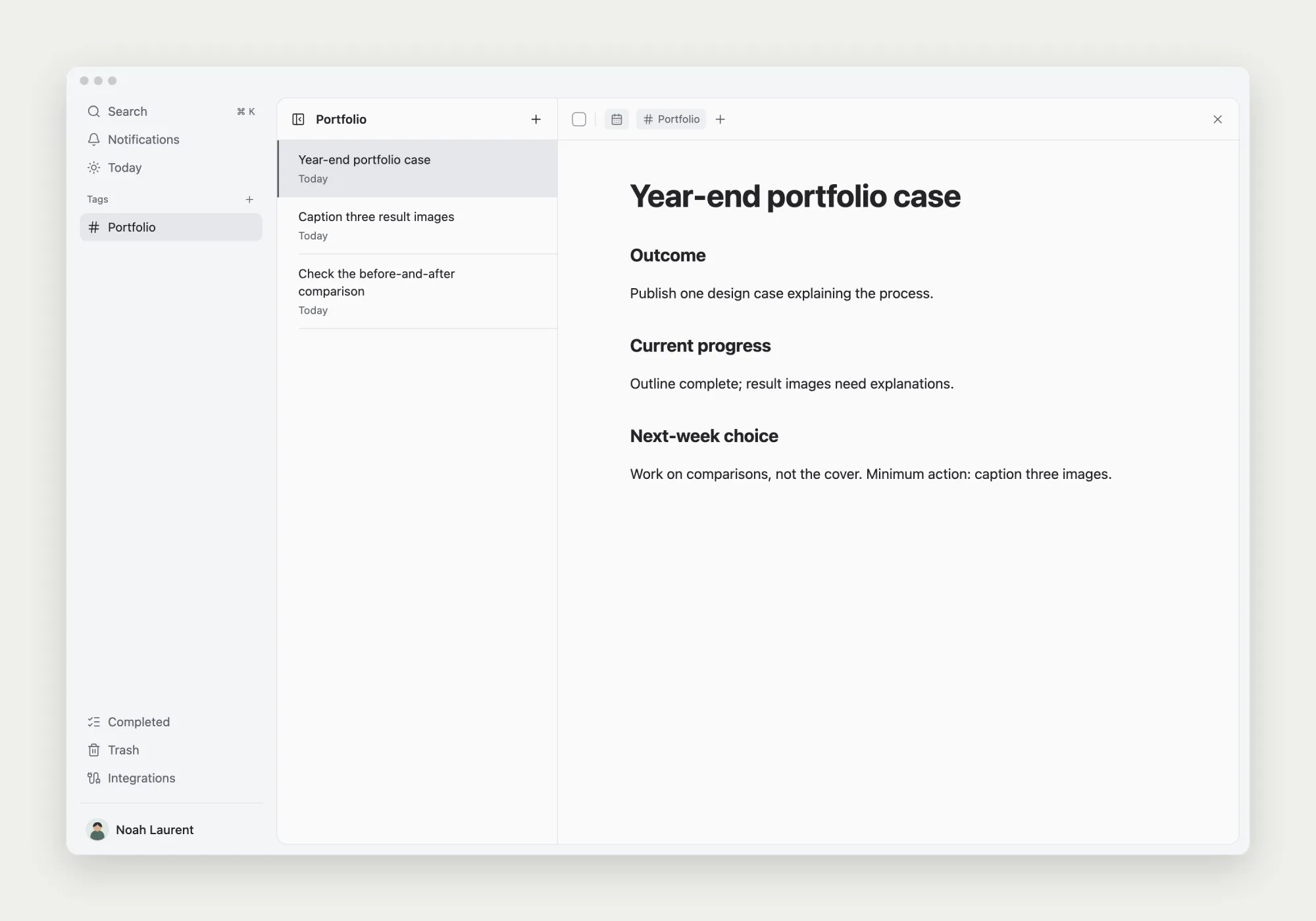
Noah has completed the case outline, but the result images still need explanations. He makes the comparison images next week's priority and postpones a cover redesign. The note preserves the trade-off; the tasks contain only the work he actually intends to do next.
A template you can copy
Starting point and review date:
One year-end outcome:
Why it matters now:

Weekly action 1:
Weekly action 2:
Weekly action 3:
Minimum version of each action:
Goals not added this round:

Actual artifact produced this week:
Reason progress stopped:
What to reduce or stop next week:
Next action and start date:
How completion will be checked:Use recurrence to support the result
TodoNote can schedule a weekly check and keep a growing project note. Repeated writing sessions may suit recurring tasks. Publishing a case is a one-time deliverable with its own subtasks. The number of generated tasks is not a measure of progress toward publication.
At the end, inspect what exists and which practices you want to continue. A goal that no longer matters can be stopped with a recorded reason. The end date provides a review point, not a demand to complete every overdue activity in one burst.
See the tasks and subtasks guide for the controls, and How to make a self-study plan with practice you can actually check for the next step.
Background reading: original source.