Weekly capacity depends on the time available and the size of the work, not the number of task cards. Subtract meetings, routine responsibilities and buffer from your working time, then compare the remainder with the estimated effort of candidate commitments.
Eight small tasks may fit more easily than two substantial proposals. Counting cards makes a tidy plan, but does not tell you whether the week can hold what you promised.
Calculate the time you can commit
Asana’s capacity planning overview compares demand with available resources. For a personal plan, check available time before committing work.
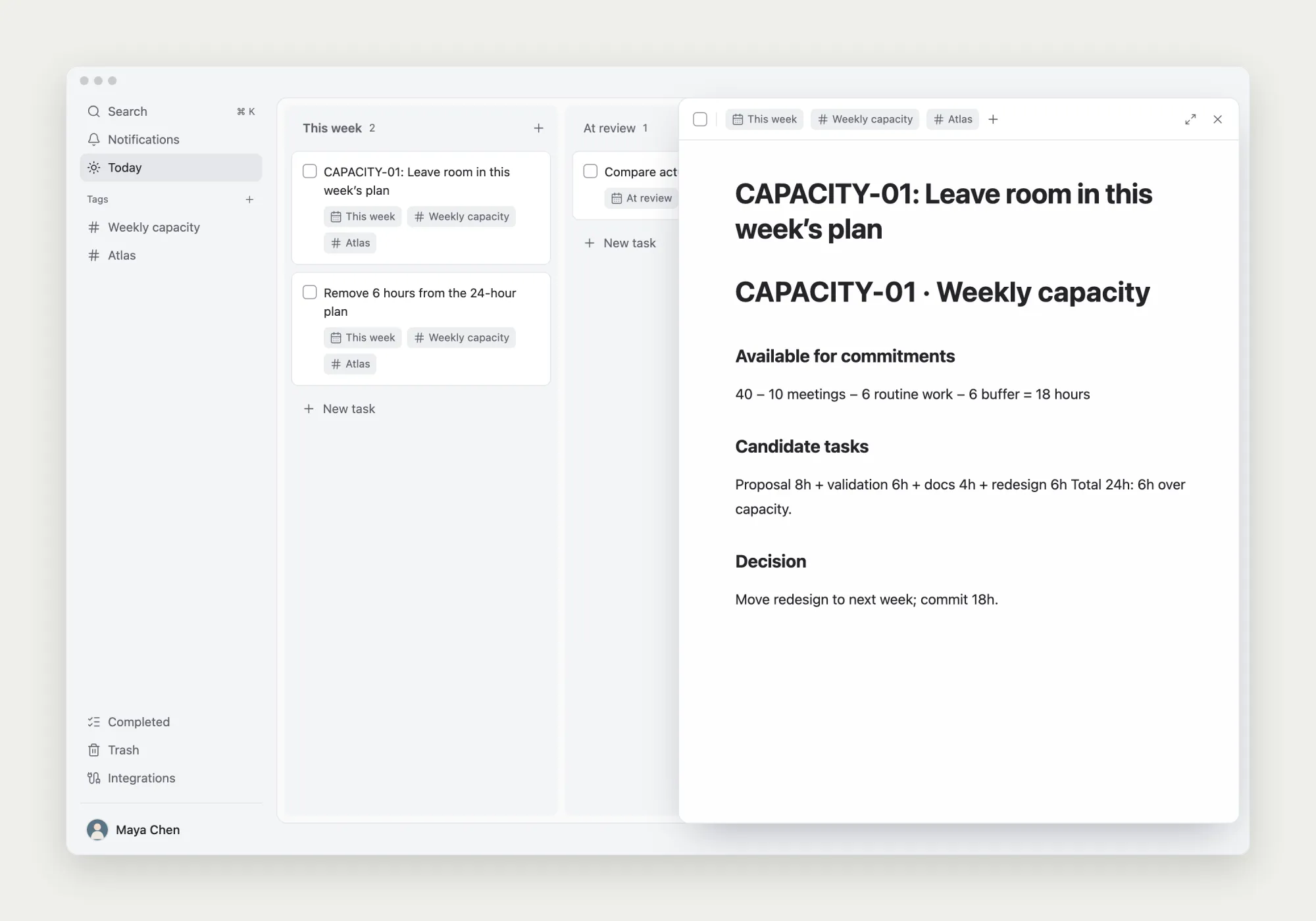
CAPACITY-01 starts with 40 working hours. Meetings take 10, routine support takes 6, and 6 are reserved for transitions and unexpected work, leaving 18. The 6-hour buffer is this example’s choice, not a universal percentage; tune it from your own records.
| Item | Hours | Treatment |
|---|---|---|
| Working time | 40 | Starting point |
| Scheduled meetings | 10 | Subtract once; avoid double counting |
| Routine support | 6 | Subtract continuing responsibilities |
| Buffer | 6 | Leave uncommitted |
| Project capacity | 18 | 40 − 10 − 6 − 6 |
Resolve the excess before scheduling
The candidate plan includes a proposal for 8 hours, validation for 6, documentation for 4 and a redesign for 6: 24 hours against 18 available. Four cards do not look excessive, but the commitment is already too large.
Moving the redesign releases 6 hours and brings the plan to 18. Other options include negotiating scope or obtaining help. Simply reducing the estimates while keeping identical work does not resolve the overload.
Make dates reflect the tradeoff
In TodoNote, keep the capacity calculation and choices in a planning note and schedule the work you actually commit to. Retain a review date and reason for deferred tasks so they do not quietly reappear tomorrow.
When an estimate has a wide range, schedule a small investigation before committing the remainder. Capacity planning needs estimates, not a falsely precise number that conceals uncertainty.
Compare the plan with the actual week
Check whether routine work was understated, buffer was sufficient and particular tasks keep spilling over. A one-off surprise does not require a new system; repeated deviations are more useful for adjusting the baseline.
Enough capacity does not mean starting every task together. Advance a few items and let completions release attention for the next ones. Weekly capacity limits commitments; execution also needs a limit on concurrent work.
Continue with: How to do a weekly work review: a template for next week’s plan