To plan dependent tasks, name why the next task cannot start and what evidence will make it ready. Separate work that genuinely needs an upstream result from preparation that can proceed in parallel, then revisit dates when the prerequisite changes.
A list’s order is not proof of dependency. You may usually write copy before building a page, but an empty page structure may not need final copy. Treating a habit as a hard constraint can unnecessarily lengthen delivery.
Identify the missing input
Asana’s dependency introduction distinguishes ready work from work waiting on another task. Ask which input the next action actually needs.
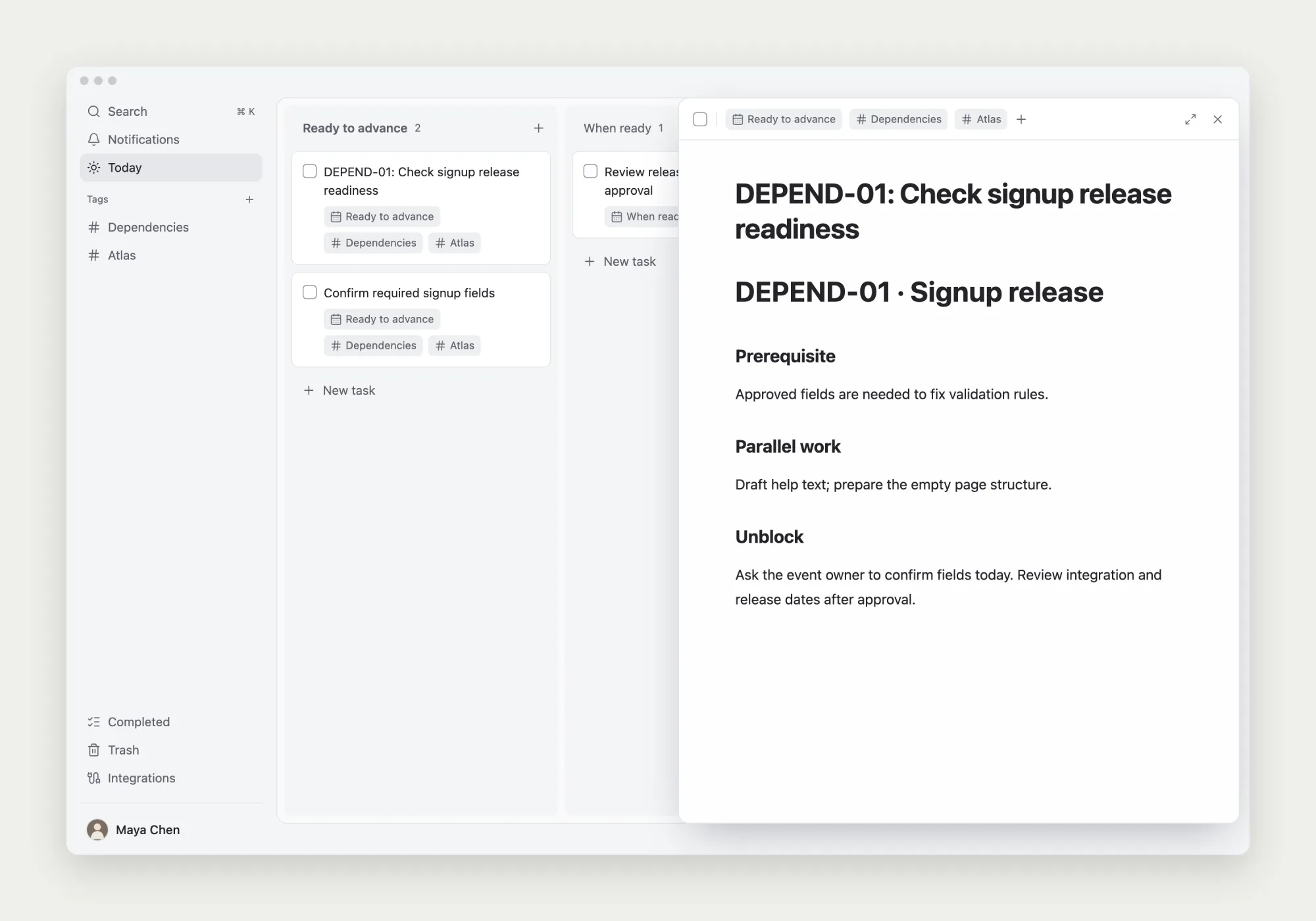
DEPEND-01 concerns an event signup page. Validation rules need final fields; release needs successful checks. Help text and an empty page structure can begin earlier. “The whole page is blocked” would conceal work that can still move.
| Work | Required input | Current response |
|---|---|---|
| Finalize validation rules | Approved field list | Get the fields confirmed |
| Prepare the page structure | Existing technical setup | Proceed in parallel |
| Draft help text | Known event rules | Write stable portions |
| Release publicly | Approved fields and passed checks | Keep the release conditional |
Define what clears the blocker
“Waiting for a reply” leaves too much unclear. Name who must confirm which material, what counts as confirmation and when to follow up. A discussion draft does not satisfy a prerequisite that requires approval.
In TodoNote, record the prerequisite’s title or an existing task link, required input and clearing condition in the task note. Create a separate follow-up action. People maintain these records, so a changed date also requires a review of the affected downstream tasks.
Review dates when the condition is met
An approval arriving one day late does not automatically delay everything by one day. Check parallel progress and remaining validation time before deciding what delivery impact exists. Reschedule the work actually affected.
If work stays blocked, inspect whether the prerequisite is too large. Confirming stable fields first may unlock part of the work. A smaller upstream decision can help more than repeatedly chasing one large deliverable.
Check dependencies when the plan changes
Ask whose input changed, which commitment is affected and who must reconfirm. Keep the revised decision with the task so nobody proceeds under an obsolete assumption.
If A waits for B and B waits for A, investigate the circular constraint. Split out a smaller initial decision or involve someone who can resolve it. Earlier due dates on both tasks do not remove the cycle.
Continue with: How to break down a task into subtasks you can start and check