PARA organizes material around projects and ongoing responsibilities. Zettelkasten develops ideas through clear notes and meaningful connections. Choose according to what you need to deliver, how you use notes and how much continuing upkeep you will sustain. They can also serve different layers of the same work.
A proposal due next week needs accessible project material. Comparing recurring research questions across several years needs more than a set of project containers. Folder counts or note counts do not tell you which need is being met.
Compare practices rather than appearances
Forte Labs explains PARA through projects, areas, resources and archives. Classification should support use.
| Dimension | PARA | Zettelkasten |
|---|---|---|
| Primary use | Retrieve material for action and responsibility | Develop and connect ideas |
| Organizing unit | Projects, areas and reference resources | An independently understandable idea |
| Upkeep | Adjust placement as work changes | Add explanations, sources and meaningful connections |
| Common failure | Collecting resources without using them | Collecting quotations without reasoning |
One study can produce two useful outputs
METHOD-01 concerns Atlas signup research. The project record holds observations, conditions and decisions. A separate idea is that early team commitment may make a first trial harder. That interpretation needs reasoning; an observation is not automatically a universal rule.
Luhmann’s system is available through the official digital archive. Here, the useful practice is preserving relationships between ideas, not copying its entire historical structure.
Keep evidence attached to the idea
In TodoNote, retain project sources and process in the original task and use topic tags to gather related research. If you write a separate idea note, preserve the source task’s title or link and explain the relationship. A shared tag alone is not an argument.
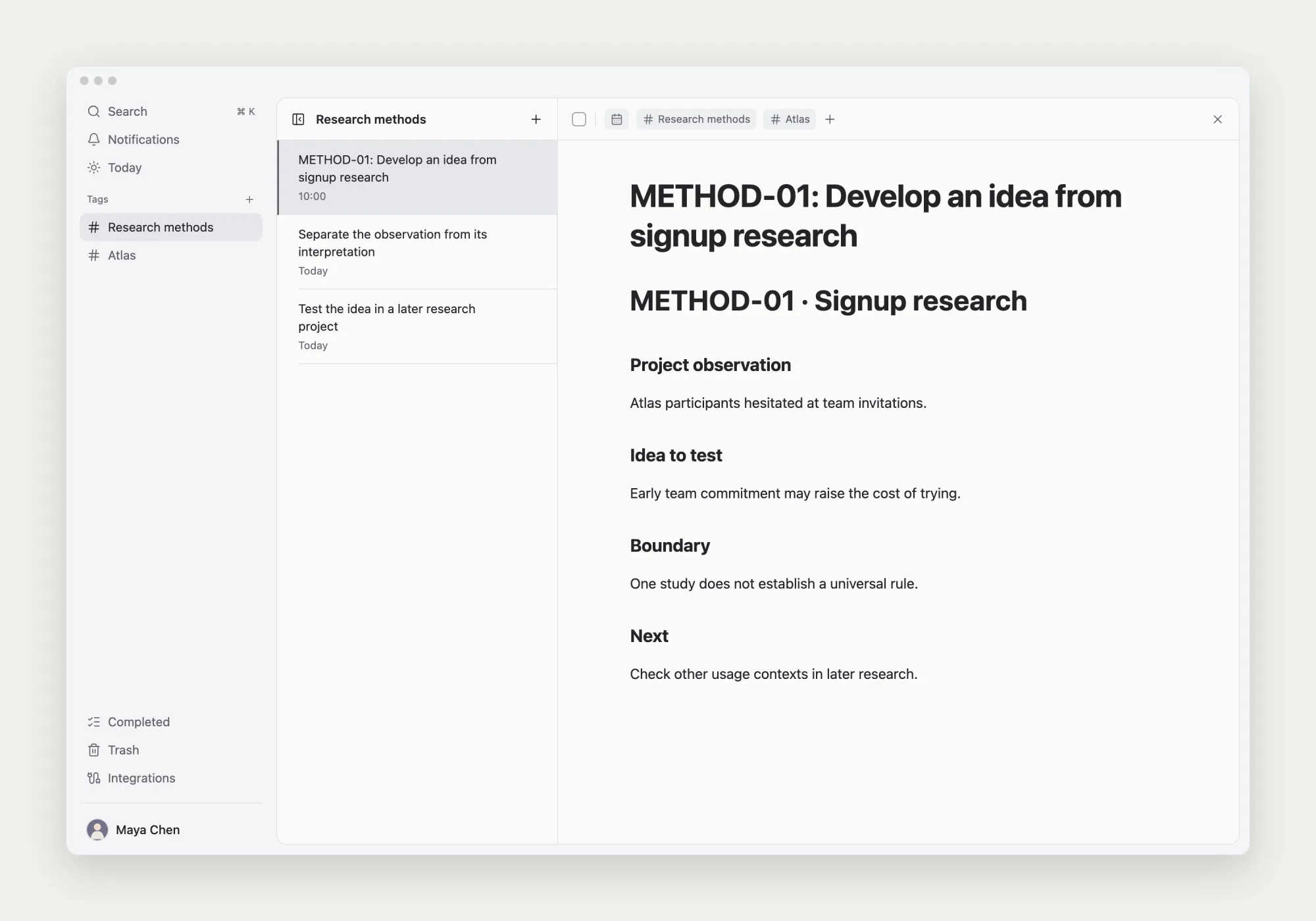
Start with one idea you genuinely need to reuse. Explain the observation, your interpretation and when it might fail. Later work can add supporting or contradictory evidence instead of quietly rewriting the claim as certainty.
Combine only where the purpose is clear
If delivery material is hard to find, begin with project access. If reading produces no usable arguments, practise explanation and comparison. You do not need two fully built systems on day one.
Review whether you can retrieve material more easily and form judgments useful to your work. Keep the practices that help delivery and thinking; simplify structures that mainly create upkeep.
Continue with: How to use PARA for notes: projects, areas, resources, and archives