Use the Feynman technique by explaining a bounded concept in your own words, finding unclear steps, checking the source and explaining it again. Keep each gap and revision in an explanation note so you can see what changed.
Familiar terminology can feel like understanding until someone asks why it works or when it fails. Save those difficult moments before polishing the wording.
Choose a concept you can finish explaining
“Why can a cache return an old value?” is a more workable scope than “learn system design.” Define the audience's starting knowledge and what this short explanation will leave out.
Caltech's learning resources describe teaching as a way to expose shallow understanding. You can speak alone or write first. The important move is identifying a missing causal step rather than hiding it behind jargon.
Make the gap specific
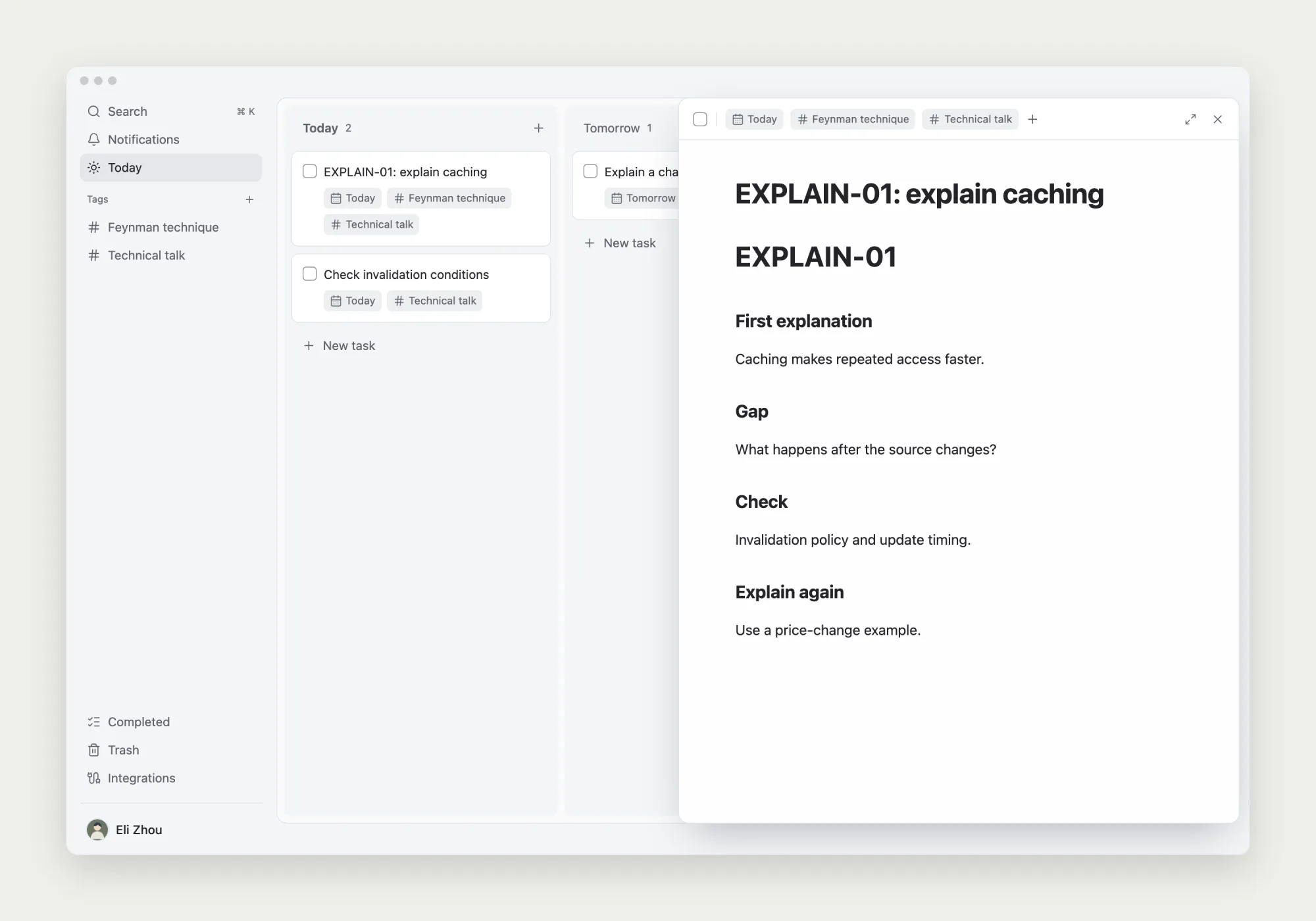
EXPLAIN-01 begins with “caching makes repeated access faster,” but cannot explain an old price after an update. That narrows the next check to invalidation and update timing instead of another broad introductory course.
| First claim | Question | Next action |
|---|---|---|
| Access is faster | Which operation is avoided? | Draw hit and miss paths |
| The cache updates | When, and what triggers it? | Check the actual policy |
| The result is current | Did the update happen before this read? | Construct an old-price example |
Keep the source location and distinguish documented behavior from your inference. An analogy can introduce an idea, but a “drawer” metaphor cannot explain expiry, invalidation and a cache miss by itself.
Test the revision with a difficult example
Explain a price change step by step: original value, update time and read path. If a sentence still says “the system handles it,” identify the mechanism. A fluent explanation still needs comparison with reliable material.
In TodoNote, use the technical-talk task note for explanation versions, gaps and sources. Turn unresolved questions into subtasks. Reopen the note at the unanswered question rather than restarting the entire reading process.
Copyable template
Concept:
Audience's starting knowledge:
Scope of this explanation:
First explanation:
Unclear sentence:
Why-question to answer:
Source and location:
What the source establishes:
My inference:
Revised explanation:
Example used to check it:
Conditions where it fails:
Remaining question:
Next explanation session:Background sources: Caltech
Related reading: How to use Cornell notes: a course-note and review template · How to make a self-study plan with practice you can actually check