A useful project retrospective compares the original intention with the observed result, examines the evidence, and chooses a small change to test next time. Record who will check that change and what result would make it worth keeping.
“Communicate more” is easy to agree with and difficult to apply. The useful question is which missing information caused a specific decision to arrive too late.
Recover the original expectation
Keep the plan as it stood before delivery. Then assemble actual results from dated task notes, acceptance records, and feedback. Avoid judging an earlier decision using information that only became available later.
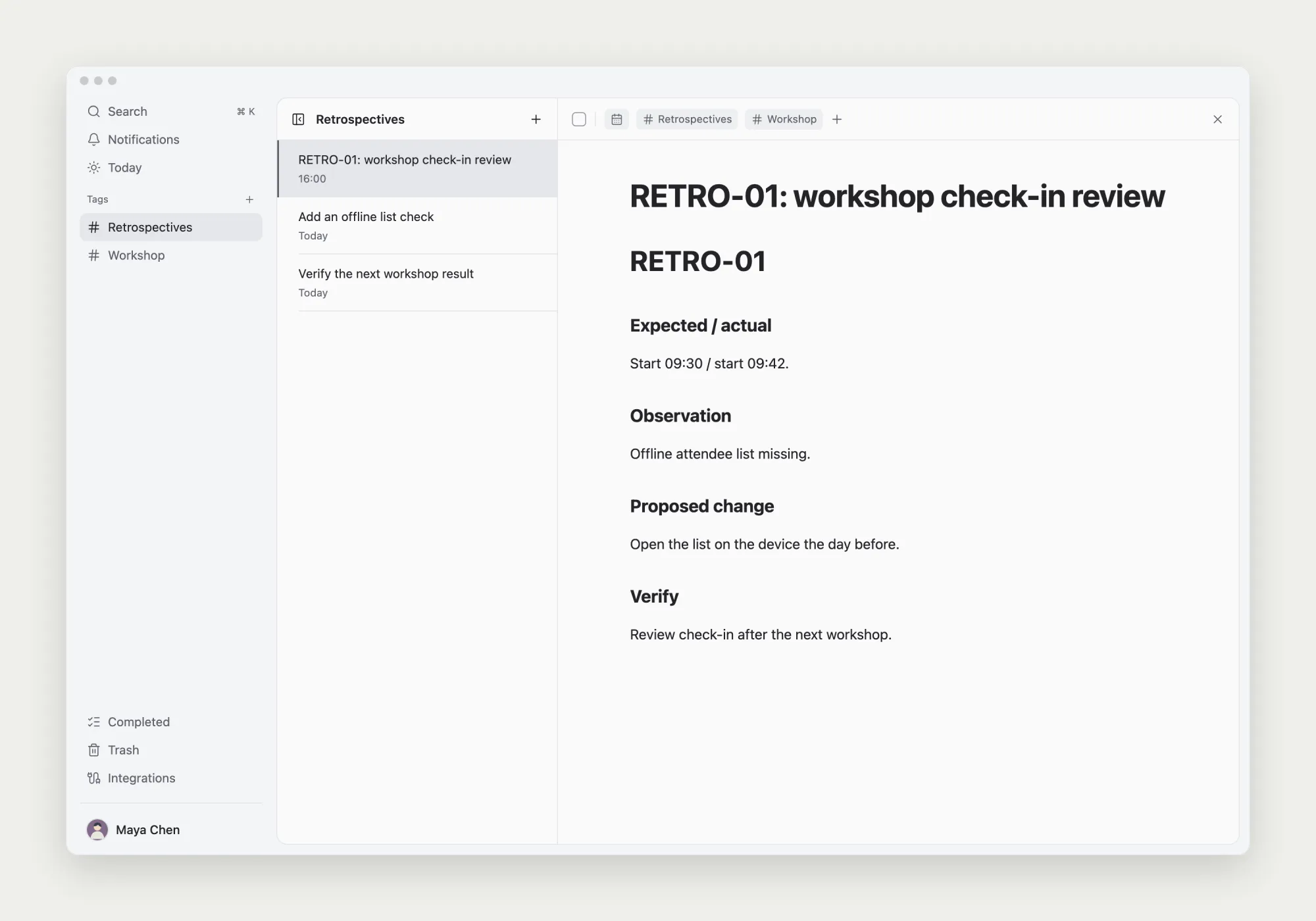
RETRO-01 reviews a workshop whose intended start was 09:30. The actual start was 09:42 because the printed attendee list was missing. The missing-list observation is evidence; explanations for why it was missing still need checking against the preparation record.
Separate observation, explanation, and improvement
| Layer | Workshop example | How to check it |
|---|---|---|
| Observation | Session began at 09:42 instead of 09:30 | Event timeline |
| Possible explanation | Offline attendee list was not verified | Preparation record and discussion |
| Improvement experiment | Open the list on the device the day before | Next workshop check |
| Verification | Compare the next check-in result | Next event timeline |
Ask what made the outcome more likely: an unclear deliverable, a late decision, an absent check, or a constraint the team could not change. Several factors may contribute. Do not convert a single person's recollection into a proven root cause.
Also preserve what worked. If the backup presentation file allowed the session to proceed, record where it was stored and when it was checked. Future planning needs repeatable strengths as well as mistakes.
Choose one change with a verification point
For the next workshop, add a check that the attendee list is available offline by 18:00 the previous day. Test opening it on the actual check-in device. Review the result after the next event before expanding the process.
Use TodoNote to keep the retrospective beside its source tasks with a project tag. Create a separate subtask for the new preparation check. Completing the retrospective does not prove that the improvement has been tried or that the next event started on time.
A retrospective record to copy
Project / completion date:
Original goal:
Expected result / source:
Actual result / source:
What worked:
Observed difficulty:
Possible contributing factors:
Evidence still missing:
One improvement to test:
Follow-up contact / date:
Verification condition:
Keep / adjust / drop after the next trial:Carry the result forward
At the next planning session, revisit the chosen change before creating new checklists. After the next delivery, compare the result and decide whether to keep, adjust, or drop the change. That second observation makes the learning usable.
Read next: Incident postmortem template: what to record after recovery
Sources and background: Atlassian