The Eisenhower matrix sorts work by importance and urgency. Importance concerns the effect on a goal or responsibility; urgency concerns a time-sensitive consequence of delay. After classifying an item, decide what action and schedule follow from that judgment.
A fresh request can feel urgent without being important. A distant deadline can hide important work that never gets started. Assess the two dimensions separately to see what repeated interruptions are pushing aside.
Give each dimension a reason
Todoist’s matrix guide distinguishes importance from urgency. Make each classification explainable with an impact and a time constraint.
Importance might involve delivery quality, user experience or a continuing responsibility. Urgency needs a more specific basis, such as a check required before tomorrow’s release. “As soon as possible” still needs a question about use and the latest acceptable time.
| Quadrant | Example and reason | Response |
|---|---|---|
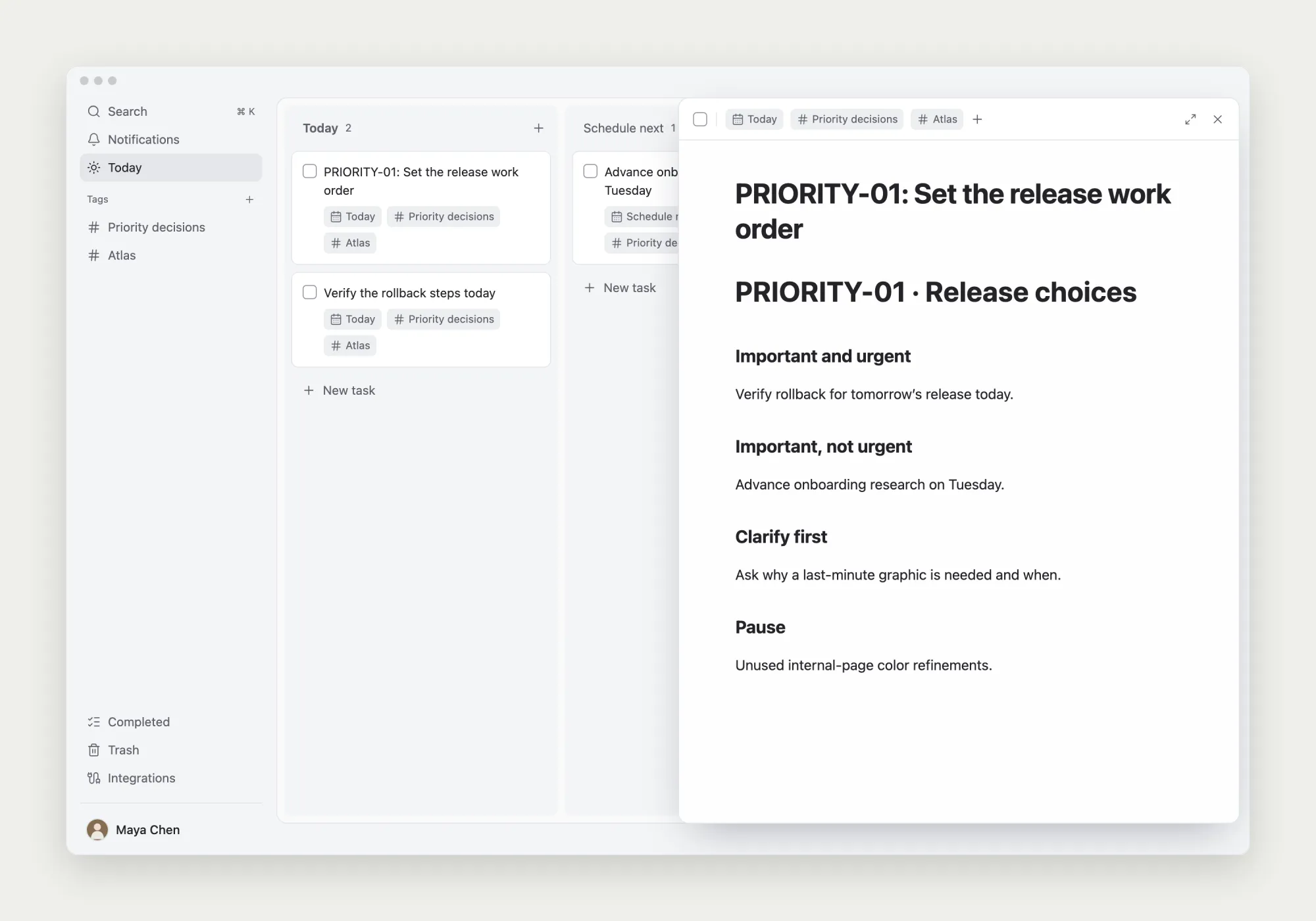
| Important and urgent | Rollback unchecked before tomorrow’s release | Verify today and record the result |
| Important, not urgent | Onboarding affects first use; no same-day deadline | Protect time and define the next action |
| Urgent, lower impact on current goals | Last-minute graphic with unclear use | Clarify, negotiate or transfer appropriately |
| Neither important nor urgent | Unused internal-page color refinements | Pause or remove |
Classify against your actual responsibilities
PRIORITY-01 belongs to a release lead, so rollback verification comes first. For a colleague responsible for event visuals, the graphic may be central work. A quadrant depends on role and goals, not just the wording of a task.
In TodoNote, record the impact, real deadline and tradeoff in the task note, then set appropriate start and due dates. A few tags can aid retrieval without requiring an elaborate second board to represent the matrix.
Give the second quadrant a concrete commitment
“Improve onboarding later” is easy to postpone. “On Tuesday, compare three recent signup reports and choose one question to test” has a start and an output you can protect.
The third quadrant is not permission to dump work on someone else. Check ownership and available time; if transfer is unsuitable, negotiate scope or response time and record the agreement.
Reassess when conditions change
An incident, delayed input or moved release can change a classification. Write down the changed condition rather than declaring every task urgent. A matrix in which everything is a crisis stops helping.
If the first quadrant stays full for weeks, review the common cause: missing preparation, too many commitments or recurring unresolved issues. Classification reveals a work pattern that still needs action.
Continue with: Another urgent request: what moves off today’s plan?